@99percentpeople/pi-codex-api
Expose Codex subscription text, vision, image, search, Fast, and usage APIs to Pi
Package details
Install @99percentpeople/pi-codex-api from npm and Pi will load the resources declared by the package manifest.
$ pi install npm:@99percentpeople/pi-codex-api- Package
@99percentpeople/pi-codex-api- Version
0.6.0- Published
- Nov 11, 2026
- Downloads
- 359/mo · 226/wk
- Author
- 99percentpeople
- License
- MIT
- Types
- extension, skill
- Size
- 464.2 KB
- Dependencies
- 0 dependencies · 4 peers
Pi manifest JSON
{
  "skills": [
    "./skills"
  ],
  "extensions": [
    "./index.min.js"
  ]
}
Security note
Pi packages can execute code and influence agent behavior. Review the source before installing third-party packages.
README
@99percentpeople/pi-codex-api
Turn your ChatGPT subscription into Pi superpowers — multilingual text and vision delegation, image generation, web search, Fast mode, and usage monitoring — no OpenAI API key required.
Pi 1.5 compatibility: text/vision delegation supports the newer
openaiChatGPT OAuth login. Search, images, quota, and reset cards still require a separateopenai-codexlegacy OAuth login; the tokens are not interchangeable.
Highlights
- Ask Codex from any model —
codex_asksends a standalone multilingual text or vision request throughopenaiChatGPT OAuth or legacy Codex OAuth. Use it for an explicit Codex second opinion, translation, rewrite, review, or screenshot analysis while DeepSeek, Google, Claude, or another provider remains active. - Tool manager — one
/99settingssubmenu independently switches Search, Image, and Ask Codex On or Off. Disabled model tools disappear from the active prompt immediately. - Answer detail —
/99settingscan leave subscription verbosity at the provider default or override normal ChatGPT OAuth replies andcodex_askwith Low, Medium, or High detail. - Image generation & editing —
codex_imagecreates or edits images via your Codex subscription (defaultgpt-image-2.5-flare), and works from any model: even with a third-party provider active (DeepSeek, Google, …), it reuses Pi's logged-inopenai-codexOAuth account (enable Other providers in/99settings). - First-party search —
codex_searchruns web and image queries, page navigation, PDF screenshots, finance, weather, sports, and time lookups, and renders clean result cards instead of raw citations. - Fast mode — requests the priority service tier on both subscription text transports, subject to model/account support; API-key traffic is not modified.
- Usage at a glance — the status bar shows remaining legacy Codex quota and
reset time;
/codex-usageshows your plan, masked account, limits, credits, and earned rate-limit reset cards. - Reset cards — when you run out of messages,
/codex-redeemredeems an earned reset card safely: pick a card, confirm, done.
Demo
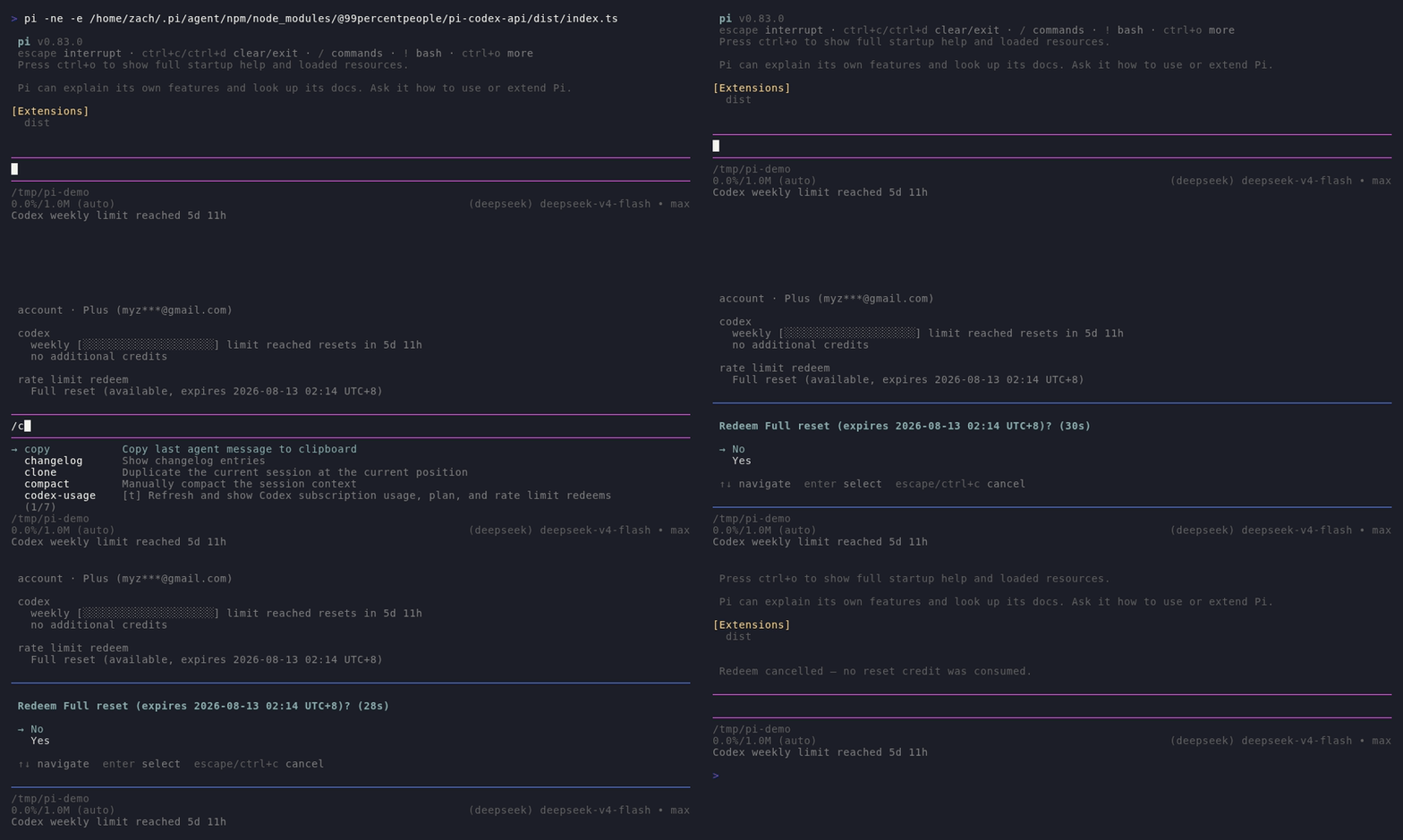
Subscription usage, limit-reached state, and reset-card redemption:
Web search with clean result cards (search → open a result → summarize):
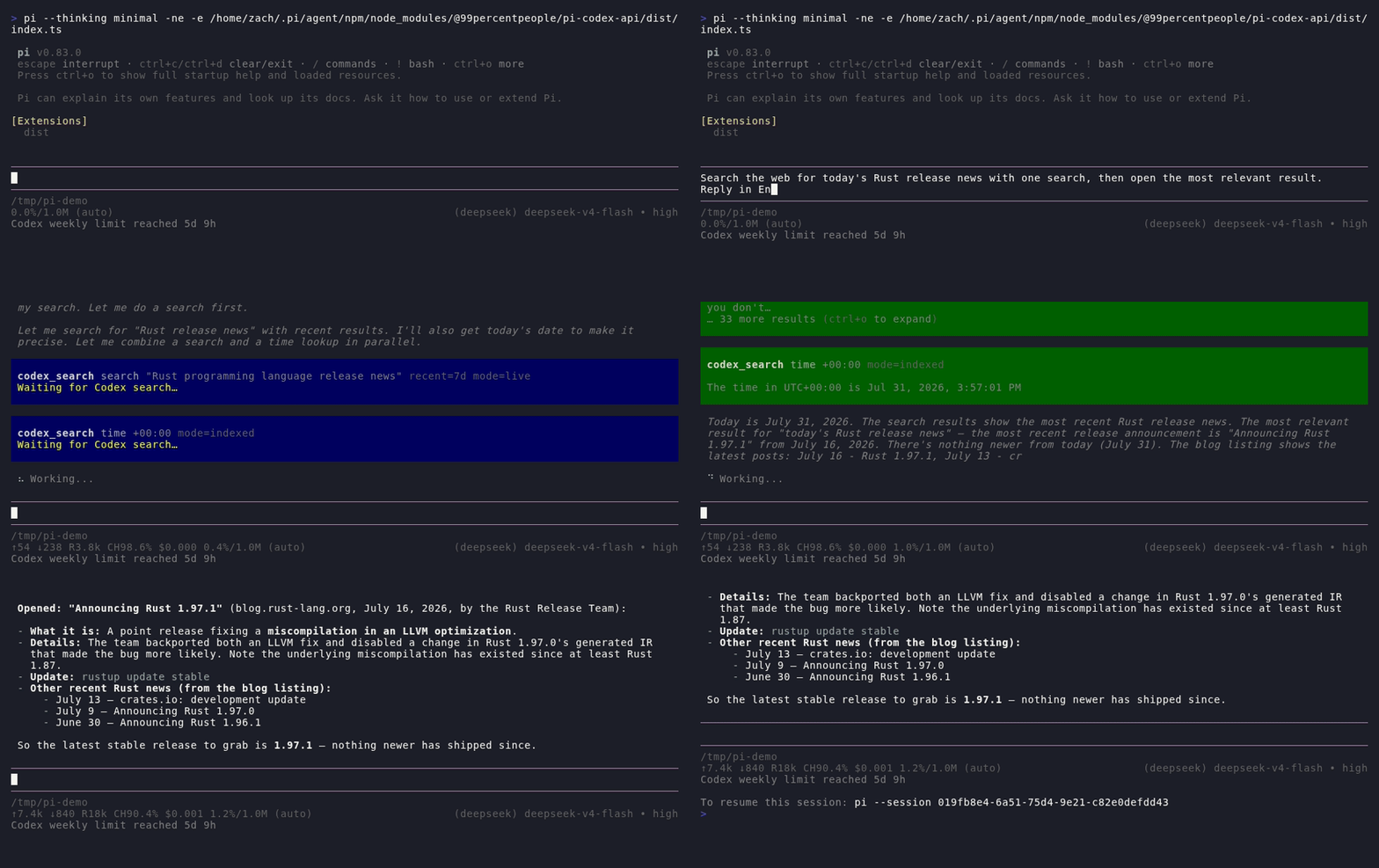
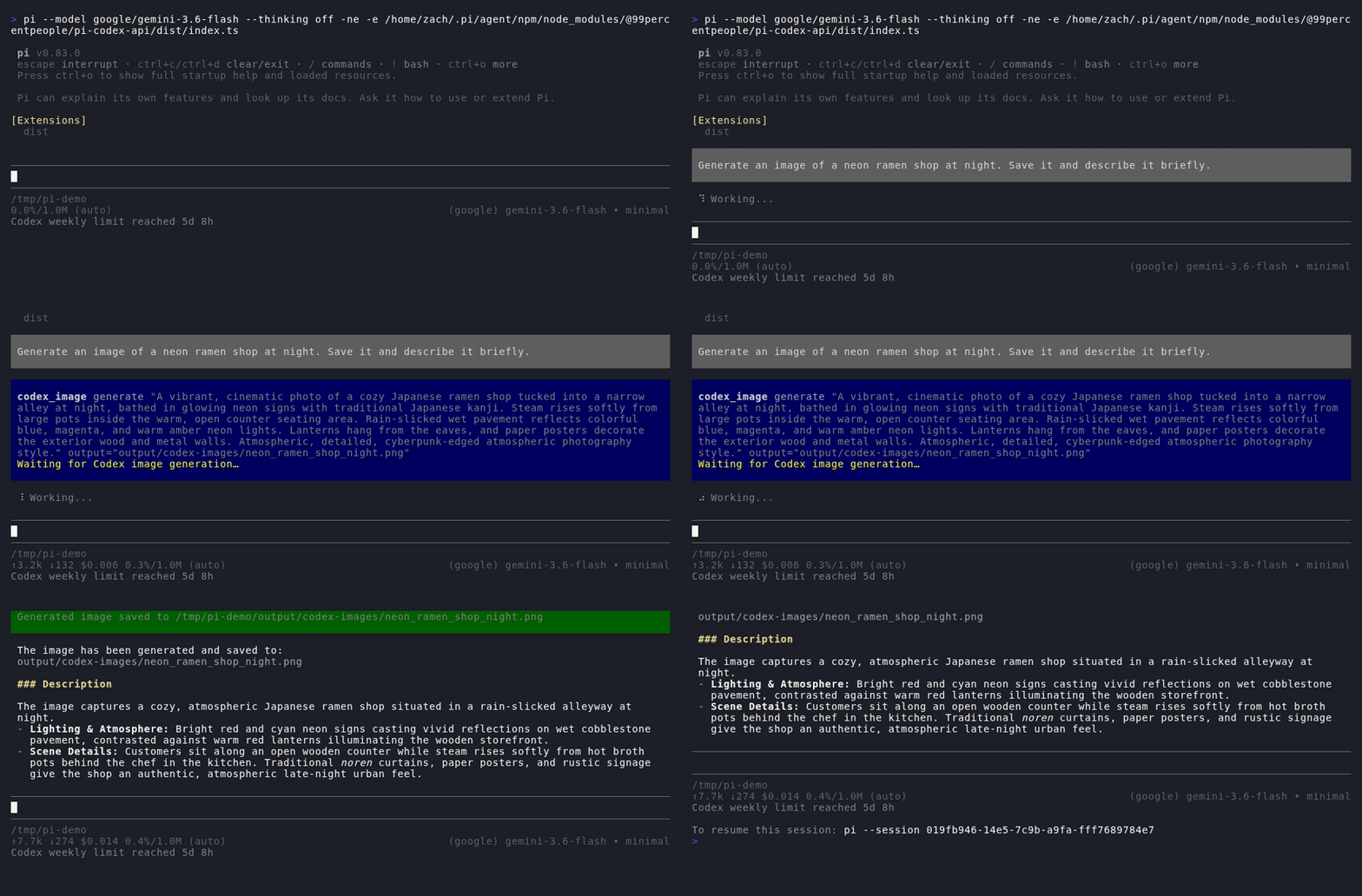
Image generation with gpt-image-2 (saved PNG + description):
Authentication and compatibility
Recommended and regression-tested SDK: Pi 1.5.0. Pi introduced the newer
openai ChatGPT OAuth login in 0.99.0. The legacy delegation path retains its
Pi 0.84.1 minimum; the peer range preserves that path, not newer OAuth on old Pi.
| Feature | Required login | Request destination |
|---|---|---|
codex_ask text/vision |
/login openai → Sign in with ChatGPT |
OpenAI Responses API (api.openai.com/v1) through Pi |
Legacy codex_ask |
/login openai-codex |
ChatGPT Codex backend through Pi |
| Search, image generation/editing, usage, reset cards | /login openai-codex |
ChatGPT backend (chatgpt.com/backend-api) |
New Pi labels openai-codex OpenAI Codex (legacy). An OpenAI API key is not a
subscription login. The extension does not move newer openai tokens to the
legacy backend, reuse legacy tokens for public API calls, or silently fall back
to API-key billing. Availability still depends on your account and workspace.
An active subscription model can use the tools without Other providers.
To invoke them while a third-party or API-key model is active, enable Other
providers in /99settings; this does not remove each tool's OAuth requirement.
If only newer openai OAuth is configured, codex_ask works, legacy commands
and quota status stay hidden, and search/image calls explain the missing legacy login.
Ask Codex
codex_ask is disabled by default. Enable Codex API → Tools → Ask Codex in
/99settings before using it. It is deliberately opt-in. The active model should call it only when
someone explicitly asks to consult Codex or requests a Codex second opinion;
it must not recursively delegate routine work just because Codex is available.
Each call is standalone. Pi does not copy the surrounding conversation or workspace into the request automatically, so the tool prompt must contain the necessary context, target language, and output format. Optional controls include:
- an exact OAuth model ID from Pi's model list; use
openai/<id>oropenai-codex/<id>to disambiguate providers; omit it to reuse the activeopenaiChatGPT model, Pi's saved OpenAI default, or the legacy catalog default (see below); - reasoning effort and per-call answer detail;
- up to five workspace images or recent conversation images for vision;
- a requested output-token cap (default 8,192), best effort only: Pi omits unsupported fields for ChatGPT sign-in, so the backend may ignore this cap.
With the newer login, no legacy model-catalog request is made. When another
provider is active, Pi's saved default is used only if defaultProvider is
openai and that model has OAuth. If no OpenAI default is saved and no legacy
login is available, select an OpenAI model with /model or specify model;
the extension does not pick an arbitrary model. If legacy OAuth is selected
and model is omitted, the existing live Codex catalog default is retained.
Explicitly requested unavailable models fail rather than switching providers.
Text calls reuse Pi's model-provider implementation and record their nested LLM usage on the tool result. One-off delegated requests use a fresh routing session and disable prompt-cache retention. With SSH Remote active, workspace image inputs are read through the remote binary file adapter. Fast mode and answer detail apply to both text transports; reasoning availability follows the selected model. Recorded token usage is not a quota snapshot or evidence of API-key billing.
Search output
codex_search keeps each result family readable:
- Web and image searches merge raw results with partial metadata into compact source cards. Partial failures and unrecognized response blocks stay visible. Citation links also resolve across short or missing separator lines.
- Pure search model output removes word-limit annotations and redundant blank lines while retaining full excerpts, dates and every source reference ID, including multiple IDs for the same URL.
- Mixed calls retain source cards, document bodies from
open/click/find/screenshot, and structured lookup cards. One combined expand hint summarizes all hidden content. Source reference IDs and document line numbers remain available for subsequent navigation; unfamiliar result text is preserved. open,click, andfindrender grouped document previews; collapsed output shows at most three documents, while expanded output keeps every result.- Weather forecasts, finance quotes, sports standings/schedules, and time lookups render structured cards. Weather alert details are reduced to their actionable summaries instead of injecting the provider's full object dump.
- Mixed model output compacts sources and lookups independently while retaining raw document blocks with their navigation metadata. Document bodies are stored once and rebuilt into cards when replaying history. All model search output is bounded to 2,000 lines or 50 KB and tells the model to open fewer references if truncation occurs.
For page workflows, search first and open returned reference IDs. Direct URLs
are best effort because Codex's browsing backend can reject otherwise valid
URLs. Keep page-navigation batches to three pages or fewer; response_length
and open.lineno do not reliably shorten page bodies.
The tool's optional search_mode accepts cached, indexed, or live.
auto is a user setting only: omit the argument to follow settings (Auto defaults
to indexed). Fixed settings take priority over the argument. If a lookup cannot
use that mode, the request switches to indexed and reports the change in its
result; for example, cached weather or live sports queries use indexed.
Current Codex backend limitations are surfaced as actionable result hints:
- Weather can become temporarily unavailable even with valid locations; retry once, then fall back to web search rather than looping over modes or locations.
- Crypto quotes require bare tickers such as
BTCorETH, notBTC-USD. - NHL standings are not served by the structured sports lookup.
finance.marketis only a provider hint and does not reliably resolve international exchange listings such as0700.HK.
When a batched lookup silently omits one item, the extension compares returned reference indexes with the request and reports the missing item's applicable hint instead of presenting the batch as fully successful.
Inline citations in assistant replies
On Pi versions exposing registerMarkdownTransformer, the extension formats
Codex citation markers such as citeturn1view0 into domain-labelled Markdown
links. URLs come only from codex_search results on the active session branch.
Multiple references are supported; missing or conflicting reference IDs display
as [turn1view0] without inventing a URL. Terminal hyperlink support determines
whether links are clickable.
Formatting is display-only: assistant text and thinking are transformed, while user messages, code examples, stored messages, and model context stay unchanged. Incomplete trailing citations are hidden during streaming. Source mappings are rebuilt on session load and tree navigation. Older Pi versions without the hook keep the original rendering; no private rendering prototypes are patched. This affects Pi's Markdown UI, not external Telegram/Feishu renderers or raw JSON exports. Other marker families (image cards, navigation widgets, etc.) are not handled by this citation formatter.
Quick start
pi install npm:@99percentpeople/pi-codex-api- Use Pi 1.5.0 (or a compatible newer version).
- For text/vision, run
/login openai, choose Sign in with ChatGPT, then select anopenaimodel with/model. Enable Codex API → Tools → Ask Codex in/99settings, then ask for an explicit Codex second opinion. - For search, images, quota, or reset cards, also sign in with
/login openai-codex(OpenAI Codex (legacy)). - If a third-party model remains active, enable Other providers in
/99settings. For newer OAuth delegation, save an OpenAI default in Pi or specify an exactopenai/<model-id>.
With the legacy login available, ask "generate an image of a neon ramen shop" or "search the web for today's Rust releases" and the model can call those tools.
When @99percentpeople/pi-ssh-remote is active, codex_image.output_path and
referenced_paths resolve through @99percentpeople/pi-workspace-files
and its remote binary backend. Generated
Base64 data is written directly through the remote adapter and references are
read directly from it, without creating local staging files.
Commands
The commands below describe legacy Codex usage and reset cards, not the
newer public Responses API's quota. They are registered only after Pi confirms
an openai-codex OAuth login. A newer openai OAuth login alone does not show them; login
and model/auth changes are detected during the session. Pi currently has no
command-unregister API, so after logging out in the same running session use
/reload (or open another session) to remove commands registered earlier.
/codex-usage
Shows a fresh snapshot of your subscription in one block:
Codex usage

account · Plus (user@example.com)

codex
  weekly [█████████████░░░░░░░] 65% left resets in 5d 3h
  no additional credits

rate limit redeem
Full reset (available, expires 2026-08-13 02:14 UTC+8)- Plan type and masked email from Codex's official usage endpoint
- Each limit window shows remaining capacity as a bar; when exhausted it reads
limit reachedinstead of0% left - Earned reset cards, sorted by expiry, with local-time expiry timestamps
- The status bar mirrors this compactly:
Codex weekly 65% 5d 3h→Codex weekly limit reached 5d 14h - When a refresh fails the status never stays on the transient
Codex syncing…: expired/invalid OAuth tokens showCodex auth expired(red), other failures keep the last known usage or showCodex usage unavailableuntil the next successful refresh
Usage refreshes automatically on session start, model select, and the configured
usage-poll interval; /codex-usage always forces a fresh read. Between refreshes,
the status-bar reset countdown advances locally from the last server timestamp
once per minute without making another request. A refresh simply re-synchronizes
that timestamp and the usage snapshot. Every usage request is capped at a
15-second timeout so a stalled backend cannot leave the status bar spinning.
/codex-redeem
Redeems an earned rate-limit reset card when you're out of messages:
──────────────────────────────────────────────
Select a reset credit to redeem (30s)

→ Full reset (expires 2026-08-03)
  Full reset (expires 2026-08-12)

↑↓ navigate  ↵ select  esc cancel
──────────────────────────────────────────────
      ↓ pick a card
──────────────────────────────────────────────
Redeem Full reset (expires 2026-08-12)? (30s)

→ No
  Yes

↑↓ navigate  ↵ select  esc cancel
──────────────────────────────────────────────- Multiple cards show a picker (earliest expiry first); a single card skips to confirmation
- No is the default, so a stray Enter never consumes anything
- Redemptions are idempotent: a retry after a network failure can never consume a second card
- Without dialog UI, it falls back to a two-step confirm flow
Settings
Configure under Codex API in /99settings:
- Tools opens one tool manager where Search, Image, and Ask Codex can each be switched On or Off. Disabled tools are removed from the active model prompt immediately; stale or concurrently queued calls are rejected before they reach Codex.
- Fast mode requests the priority service tier for normal ChatGPT OAuth
replies and
codex_ask, on both supported text transports. - Usage monitor controls only legacy Codex background status refreshes.
Turning it off leaves explicit
/codex-usageand/codex-redeemavailable when legacy OAuth is configured. Normal newer OpenAI replies do not trigger legacy quota refreshes or parse their response headers as Codex quota. - Answer detail selects provider default, Low, Medium, or High verbosity for
normal subscription replies and
codex_askunless a call overrides it. - Other providers permits calls from non-subscription active models (DeepSeek, Google, API-key OpenAI, …). Each feature still requires its own subscription OAuth login; the default ChatGPT only does not permit API-key traffic.
- Search mode and Search context configure search when its feature is on.
- Image model selects
gpt-image-2.5-flare(default, fast generation),gpt-image-2.5-sunburst(precise editing), orgpt-image-2(compatibility). Existing settings withoutimageModeldefault to Flare. Changes apply on the next call. - Image quality sets the GPT Image default when its feature is on.
- Usage poll controls the monitor refresh interval when its feature is on.
Settings live in ~/.pi/agent/99extensions.json under the codex-api
namespace. Search and Image default to enabled; Ask Codex defaults to disabled.
Existing explicit tool settings are preserved; configurations without an
askEnabled setting also default to disabled.
Images 2.5 availability
OpenAI announced Images 2.5 on September 8, 2026.
The model IDs are gpt-image-2.5-flare and gpt-image-2.5-sunburst, not
gpt-image-2.5. This extension sends the selected ID to the existing Codex
subscription generation/edit endpoints, not the public paid Images API.
Both new IDs have mock request coverage. A single gpt-image-2.5-sunburst
generation passed a legacy OAuth live smoke test on 2026-11-09; Flare and
image editing remain unverified live. Account availability depends on the Codex
rollout. If the backend rejects a new model, select gpt-image-2 in Image model.
There is no silent fallback or automatic retry that could generate a second image.
The existing conservative size limits, five-reference limit, and
auto/low/medium/high quality choices are retained for the subscription
backend; additional public API options are not assumed to be supported.
The bundled prompting skill and demo were originally written for GPT Image 2.
How it works
- Reuses Pi's subscription OAuth logins — no API key, MCP server, or separate search provider; newer OpenAI and legacy Codex credentials stay isolated
- Tokens are resolved per call inside Pi, never stored in settings or tool results
codex_askuses Pi's authenticated model completion API so provider overrides, token refresh, and transport remain inside the model registry. OAuth is checked again before completion; newer HTTP delegation also refuses actualsk-API keys even if the registry's OAuth snapshot became stale- Legacy backend requests honor resolved base URLs only on the exact HTTPS
chatgpt.comorigin and reject URL credentials and redirects. Nullable optional headers delete defaults rather than sending"null"; mandatory authentication headers are always rebuilt from the selected legacy credentials - The extension also ships the
gpt-image-promptsskill for crafting production-grade image prompts — invoke it with/skill:gpt-image-prompts
Validation and development
The Pi 1.5 adaptation has mock coverage for both login families, provider/model selection, API-key rejection (including a real-registry stale-auth case), nullable headers, usage isolation, and text/vision requests through Pi's real Responses adapter with HTTP mocked.
Live smoke test, 2026-11-09: existing legacy OAuth successfully handled
standalone text, vision input, web search and opening a returned reference,
a structured time lookup, WHAM usage and reset-card reads, and one PNG generation
with gpt-image-2.5-sunburst. The PNG signature and dimensions were checked, and
the vision call correctly described the generated image. Ordinary OpenAI API-key
authentication was also confirmed to be refused before subscription delegation.
The newer openai ChatGPT OAuth path remains mock-covered only; it was not
live-tested without that login. Flare generation, image editing, other search
families, priority tier, and reset-card redemption were not live-tested in this
smoke run. No login/settings were changed and no reset card was consumed.
These results are account-scoped, not a guarantee of availability for every account.
bun install
bun run lint
node --import tsx --test tests/codex-api.test.ts tests/codex-api-oauth.test.ts
bun run check:privacy
bun run check
bun run pack:codex-api
pi -e ./extensions/codex-api/index.ts
Development SDK versions are pinned to Pi 1.5.0. Pi-provided runtime packages
remain external in dist/codex-api/index.min.js; the npm staging package also
contains its linked source map, both READMEs, license, and prompting skill.