@ellieyujin/pi-reopen
Restore recorded Pi sessions in Windows WezTerm tabs from WSL; includes a Pi extension and standalone CLI.
Package details
Install @ellieyujin/pi-reopen from npm and Pi will load the resources declared by the package manifest.
$ pi install npm:@ellieyujin/pi-reopen- Package
@ellieyujin/pi-reopen- Version
0.2.0- Published
- Nov 13, 2026
- Downloads
- 1,032/mo · 599/wk
- Author
- abelxiaoxing
- License
- MIT
- Types
- extension
- Size
- 91.2 KB
- Dependencies
- 0 dependencies · 2 peers
Pi manifest JSON
{
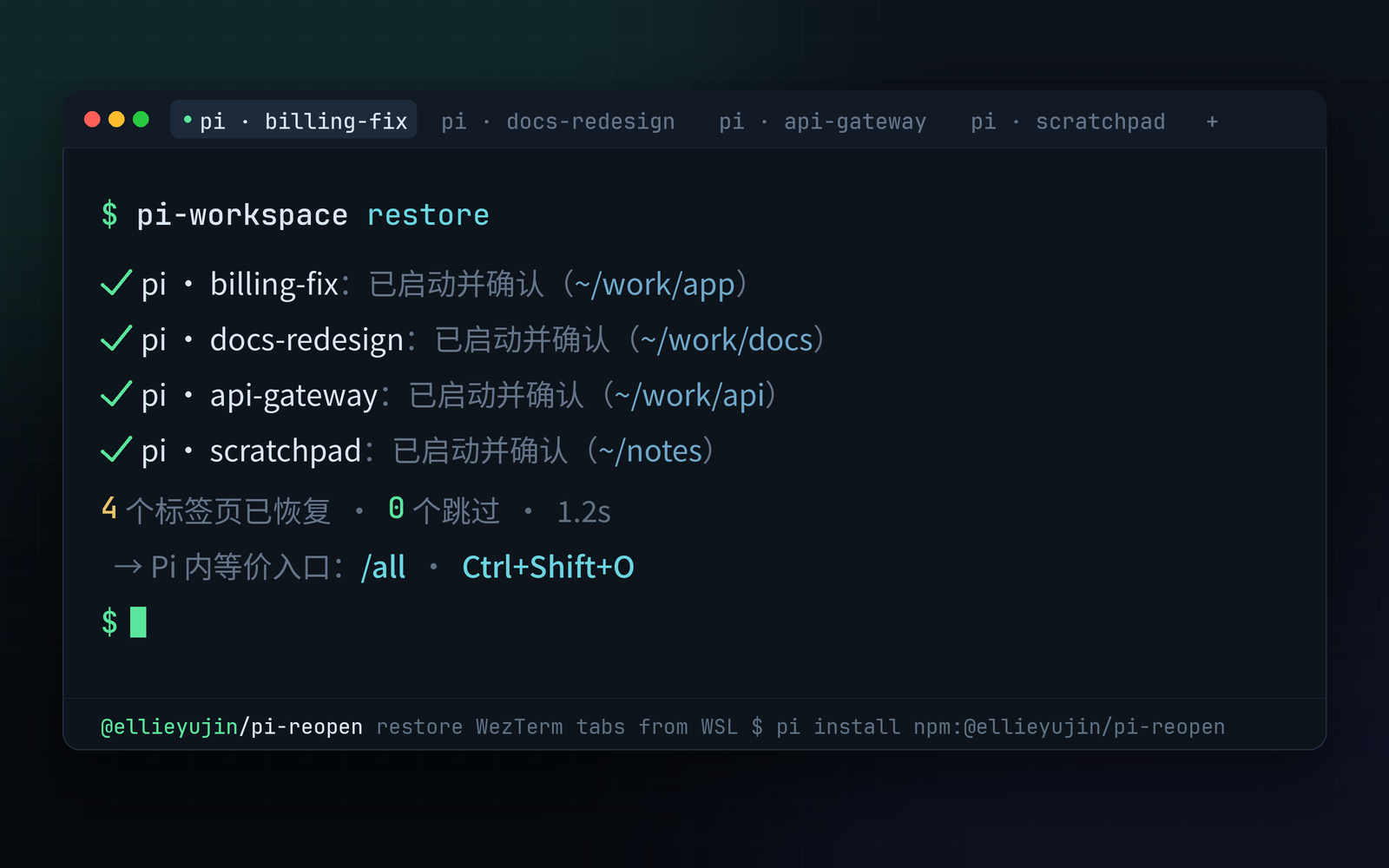
  "image": "https://raw.githubusercontent.com/AuthurX/pi-workspace/main/assets/preview.png",
  "extensions": [
    "./extensions/open-all.ts"
  ]
}
Security note
Pi packages can execute code and influence agent behavior. Review the source before installing third-party packages.
README
pi-reopen
One command to recover the Pi terminals that were still open when WezTerm closed: restores the original working directory, loads the original conversation, and waits for your input.
A Pi package: the Pi extension registers every open Pi in real time, and the standalone pi-reopen CLI reopens them as tabs through Windows WezTerm, with environment preflight, deduplication, and concurrency protection.

Requirements
- WSL (Windows) + Windows WezTerm: the only supported restore target
- Node ≥ 22.19, with Pi installed
- Non-WSL Linux / macOS / native Windows: not supported (restore and liveness checks depend on WSL / Linux)
- Restore runs as the default user of the target WSL distro; run this tool as that user
Usage
pi-reopen ✔ pi-workspace:已启动并确认(/home/ellie/work/MY/code/pi-workspace)
⚠ other-proj:已创建标签页,超时未确认 pi 启动(/home/ellie/work/other-proj)
已处理 2 个CLI output is in Simplified Chinese: 已启动并确认 = launched and confirmed; 超时未确认 pi 启动 = tab created, timed out waiting for pi confirmation; 已处理 N 个 = N processed.
Equivalent entry points inside Pi:
/all— restore registered Pis/all recent— pick up from conversation history of the last 24 hours (for unregistered windows)/all clear— clear the registry (does not delete conversation files)Ctrl+Shift+O— one-click restore
Commands
| Command | Description |
|---|---|
pi-reopen (i.e. pi-reopen restore) |
Reopen the Pis still open at last close; running ones are skipped |
pi-reopen restore --dry-run |
Show the plan only, do not open tabs |
pi-reopen restore --no-wait |
Skip waiting for each pi's start confirmation |
pi-reopen list |
List registered members and status; long content is truncated to terminal width by default |
pi-reopen list --wide |
No truncation |
pi-reopen doctor |
Environment check (WSL distro / interop socket / WezTerm / pi) |
pi-reopen clear |
Clear the registry and start claims (does not delete conversation files or legacy-format records) |
list statuses (labels in Chinese): running (运行中) / pending restore (待恢复) / start claimed (启动占用中) / working directory missing (工作目录缺失) / session file missing (会话文件缺失) / duplicate entry (重复条目).
Exit codes: 0 success; 1 restore failed or unknown command; 2 environment preflight failed.
Installation
From npm
Use the full package name @ellieyujin/pi-reopen with the next dist-tag. The unscoped pi-workspace on npm is a different author's project.
pi install npm:@ellieyujin/pi-reopen@next
npm install -g @ellieyujin/pi-reopen@next --omit=peer
pi-reopen doctor
pi installregisters and loads the extension, but does not guarantee the CLI is on a regular shell's PATH;npm install -ginstalls the external CLI (the npm global bin directory must also be on PATH)- The CLI does not depend on Pi's peer packages, hence
--omit=peerto avoid installing the host as well; the two installs must be updated separately and kept at the same version
Registration requires the extension: installing only the CLI cannot record sessions. After install, run /reload or restart in each already-open Pi; a fresh install cannot precisely recover previously unregistered windows. Do not load an old open-all.ts copy/symlink at the same time as the package; before migrating, check pi list and the personal extension directory, disable the old entry only, and do not delete session or auth files.
From source
The following commands run inside WSL and install the currently checked-out source:
git clone https://github.com/AuthurX/pi-workspace.git
cd pi-workspace
pi install .
mkdir -p "$HOME/.local/bin"
ln -s "$PWD/bin/pi-reopen.js" "$HOME/.local/bin/pi-reopen"
export PATH="$HOME/.local/bin:$PATH"
pi-reopen doctor
Save the PATH configuration in your shell startup file for future use. If the CLI symlink already exists, check its target first; do not blindly overwrite it.
If you only need the extension, you can also install the pushed Git version directly:
pi install git:github.com/AuthurX/pi-workspaceOptional Configuration
| Environment variable | Purpose |
|---|---|
PI_WORKSPACE_WEZTERM |
Absolute path of Windows WezTerm inside WSL, e.g. /mnt/c/Program Files/WezTerm/wezterm.exe |
PI_WORKSPACE_PI_BIN |
Absolute path of the Pi executable inside WSL, no arguments; aliases and shell functions are not supported |
PI_CODING_AGENT_DIR |
Use a different Pi config/registry directory; CLI and extension must stay consistent |
PI_WORKSPACE_SRC |
Development only: overrides the shared src/ directory; not needed for normal package installs |
For example, if Pi is installed via nvm, pnpm, or a custom npm prefix, set it explicitly:
export PI_WORKSPACE_PI_BIN="$(type -P pi)"
export PI_WORKSPACE_WEZTERM="/mnt/c/Program Files/WezTerm/wezterm.exe"
pi-reopen doctor
By default Pi is located from the caller's PATH and the Bash login environment; npm install directories are not guessed. Restored tabs use the Pi path from preflight and explicitly pass the caller's PATH and agent directory; the full environment or auth information is never appended to the command line. WezTerm auto-discovery checks PATH, common install locations, and where.exe (converted via wslpath), in that order; for uncovered layouts such as custom drive mount points, set an explicit path. After changing environment variables, restart the Pi process; /reload does not read the parent shell's new environment.
How It Works
- Registration: on every Pi startup,
{session file absolute path, cwd, pid, processStart, bootId}is written in real time to~/.pi/agent/pi-workspace/members/(one file per session, atomic replacement). - Close detection: Pi's signal exits also emit a
quitcleanup event, so the event name alone is not reliable. The extension records SIGHUP/SIGTERM within the TUI lifecycle: signal exits keep the record; a signal-less deliberate/quitor session switch deletes the record; reload keeps the record and cleans up listeners. When a hard kill prevents cleanup, the leftover is recorded. On power loss, at most the persisted records are recovered; the latest unflushed changes are not guaranteed. - Safe startup: each
wezterm cli spawnrequest is aborted with an error after 15s of no response, and 3 consecutive request failures stop early, avoiding long waits when WezTerm is stuck; by default it waits for all pis to start and register before reporting,--no-waitskips this. - Deduplication: before restore, process liveness is checked (pid + start time + bootId; stale PIDs after a reboot are not misjudged), and start claims (60s TTL + holder liveness check) reduce duplicate requests. A global restore lock (
restore.lock, 30-minute TTL + pid liveness + bootId check) rejects concurrent restores; it can be taken over after the lock holder dies or WSL reboots. - Safety: if preflight (distro / interop socket / WezTerm present and executable / pi available) fails, nothing is launched in bulk; never auto-sudo; ENOEXEC comes with a fix hint; "tab created" and "pi start confirmed" are reported separately.
Development & Testing
# from the repo root
npm test
npm pack --dry-run
extensions/open-all.ts Pi extension (thin adapter layer): registers live Pis, provides /all
src/ shared core (pure JS ESM, used by both extension and CLI)
paths/liveness/members/claims/plan/preflight/discover/launch/spawn/verify/restore/cli
bin/pi-reopen.js CLI entry point (run directly with node, no build step)
test/ Node built-in tests (isolated dirs + injected mocks, no real terminal calls)
docs/ requirements and statusTests cover core restore, signal handling order, reload cleanup, /all recent picking, non-standard Pi install paths, shell escaping, and loading after the package moves; tests are isolated via temporary directories and a mock launcher. The test hook PI_WORKSPACE_HOOKS should not be set during normal use.
Optional Pi PTY test: python test/pty-shutdown.py. Uses a temporary config and session, checking that signal exits keep the member and a deliberate /quit removes it; no model calls, no visible tabs.
Maintainer release steps: see the publishing guide.
Contributors
License
MIT, Copyright (c) 2026 ellieyujin