pi-infinity
Non-blocking execution, durable timers, and parallel subagents for pi.
Package details
Install pi-infinity from npm and Pi will load the resources declared by the package manifest.
$ pi install npm:pi-infinity- Package
pi-infinity- Version
0.1.5- Published
- Nov 10, 2026
- Downloads
- 609/mo · 609/wk
- Author
- alienstoearth.dev
- License
- MIT
- Types
- extension
- Size
- 280.8 KB
- Dependencies
- 0 dependencies · 4 peers
Pi manifest JSON
{
  "extensions": [
    "./extensions/index.ts"
  ]
}
Security note
Pi packages can execute code and influence agent behavior. Review the source before installing third-party packages.
README
pi-infinity
Non-blocking execution, durable timers, and parallel subagents for pi.
Run background commands, delegate to child threads, and receive results without polling. Optionally give each child its own git worktree or jj workspace.
This is an independent pi package inspired by the Infinity agent runtime, not Infinity itself.
- Install
- How it works
- Tools
- Guards
- Threads and sandboxes
- Commands
- Configuration
- Limits
- Troubleshooting
- Development
- License
Install
Requires pi 1.4+ and Node 24+. Install from npm:
pi install npm:pi-infinityThis installs pi-infinity only. For threads, install pi-interactive-subagents or pi-subagents separately; missing thread agents are linked on startup. Interactive threads also require tmux; sandboxes require git or jj. Jobs and timers work without a thread transport.
You can also install git:github.com/AliensToEarth/pi-infinity directly.
Alternatively, run ./scripts/install.sh from a checkout to install pi-infinity and, if
missing, pi-interactive-subagents, and link the thread agents in one step. It requires pi,
Node 24+, git and tmux; start or reload pi inside tmux to use interactive threads. Existing
packages and agent files are preserved, with conflicts reported.
How it works
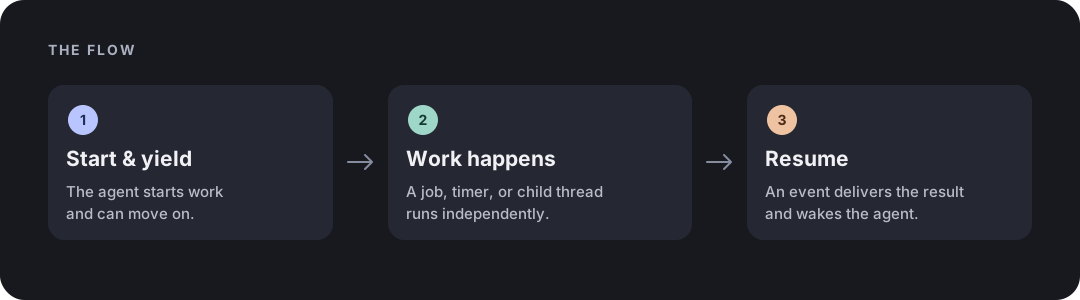
Job exits, watched output, timers, and child reports arrive as infinity-event messages.
For example:
[infinity event] job_exit from bg_run (call_abc)
original_args: {"command":"npm test"}
---
job j1 "npm" finished: exited (exit code 0, 42s)
command: npm test
log: <session artifacts>/infinity/jobs/j1.log (2 lines, 23 bytes)
--- last 2 lines ---
Tests: 12 passed
Done.
Events are recorded before delivery and replayed after a restart if absent from the session transcript; this does not prove the agent processed them, and a crash can cause duplicates. By default, bodies over 4,000 characters spill to a file. Events steer the agent, but pending user messages take priority.
The sleep tools yield without another model call. Timers survive restarts; overdue timers fire with a note that they were late.
Tools
| Tool | Purpose |
|---|---|
bg_run |
Start a shell command in the background and return at once. The exit arrives as an event. Optional watch regexes and write isolation. |
bg_output |
Read a job's output without waiting, as a tail or a byte range. |
bg_cancel |
Cancel one job or all. SIGTERM, then SIGKILL after 3 s. Safe to repeat. |
bg_list |
List jobs. |
sleep |
Durable timer. Ends the turn, a timer event wakes the agent. |
sleep_until |
Same, for a wall clock time in an IANA zone. |
sleep_until_event |
Yield with nothing scheduled and wake on any event or user message. |
timer_cancel |
Cancel timers. |
spawn_thread |
Start a child thread with an optional fresh context and sandbox. |
assess_coverage |
Compare assigned and reported line ranges, without verifying source files. |
send_message_to_child |
Message a running direct child. |
squash_sandbox |
Merge a child's sandbox into the caller's tree. |
report_to_parent |
Thread sessions only. Intermediate report. |
close_thread |
Thread sessions only. Final report, ends the session. |
Background jobs in detail
Jobs run through /bin/sh -c in a process group and write output to a log. bg_output reads
up to 8,000 bytes at a time. A user interrupt leaves jobs running; session shutdown cancels
running shells. Cancellation targets the process group, but descendants of an already-exited
shell may survive.
Use timeout_seconds to stop a long-running job. The default limit is eight concurrent jobs.
watch accepts regex patterns and batches matching lines into events, limited by default to
six per minute per job; suppressed matches are counted in the exit event. Set
associative: true to disable that rate limit. Matching uses synchronous JavaScript regexes;
pathological patterns can block pi, so use simple, trusted patterns.
Guards
Bash guard. The classifier refuses sleep 60, tail -f, watch, endless loops and
foreground dev servers such as npm run dev or python -m http.server, with a message that
points to bg_run or sleep. It is deliberately narrow:
- Commands inside quotes are not scanned.
- Commands that are backgrounded with
&, or wrapped innohup,setsidortimeout, pass. - Short sleeps pass. The limit is 20 seconds.
By default, bash calls that have no timeout get one of 180 seconds.
Result guard. By default, a tool result over 40,000 characters is saved to a file and replaced by its
head, tail and the path, with a hint to page through it with read. read itself is exempt,
so the saved file can be read in pieces without being spilled again.
Optional background process isolation
bg_run({command: "npm test", cwd: "/path/to/project", isolate: true}) limits filesystem
writes to the canonical cwd. It uses /usr/bin/sandbox-exec on macOS and bwrap
(bubblewrap) on Linux. Isolation is off by default and requires an explicit cwd.
Unsupported platforms or a missing isolation tool fail closed; if initialization fails,
the job exits without running its command. Linux also requires working user namespaces,
which may be disabled by system policy. Logs are written by pi outside the sandbox.
This reduces accidental writes, not a security guarantee. Reads and network access remain
allowed, other processes may be contacted, and all files within cwd remain writable.
Hard links inside cwd can refer to the same data as files outside it; writable nested
mounts and cooperating processes can also affect other locations. Choose a narrow directory;
/ provides no useful write restriction. Tools that write caches or temporary files outside
cwd may fail. macOS sandbox-exec is deprecated and may change or disappear. Git worktrees
and jj workspaces are separate checkout isolation, not process security boundaries; threads
can access the caller's environment.
Threads and sandboxes
spawn_thread({ instructions: "...", child_of: ["root"], fresh_context: true, sandbox: true })- Scoped models. When
/scoped-modelsselects models,spawn_threadand direct pi-interactive-subagents calls use only those models. Omitted overrides use the current model if it is scoped, otherwise the first scoped model. Use an exactprovider/modelIdor an unambiguous model ID for an override. With no scope, existing defaults apply. This guard is not a security boundary: independently launched processes and child sessions that do not load pi-infinity are outside it, and a parent-only--modelsscope is not automatically inherited. - Context.
fresh_context: truestarts with empty history, so instructions must be self-contained. Forked context is available only with pi-interactive-subagents. - Stack.
child_ofmust match the caller's thread stack, root first. This prevents a forked child from replaying its parent's pending spawns. - Reports. Interactive children can call
report_to_parentandclose_thread; exiting without closing also closes the thread.send_message_to_childreaches running direct children only. Spawn a new thread to continue after closure.
Sandboxes and dependencies
- Sandboxes.
sandbox: truegives the child a checkout under.pi/sandboxes/<id>on asandbox-<id>branch (git worktree) or bookmark (jj workspace). The backend is chosen automatically and jj wins when the repository uses it. By default, the child's work is committed when it closes, and the event shows the diff stat. - Merging back.
squash_sandboxmerges the branch into the caller's tree. In your main session the changes are only staged (git) or left in the working-copy change (jj), and you confirm first. Inside a sandboxed thread the result is committed. On conflict the sandbox is preserved; the target may need manual recovery. Git removal refuses to discard ignored files. Automatic jj bookmark pruning is disabled to avoid deleting work moved concurrently. - Dependencies.
depends_on: ["t-..."]requires direct children to have closed without a known failure. Unmet dependencies reject the spawn; they are not queued. Interactive child completion does not prove its task succeeded, so inspect its report first. Dependencies are session-local.
Reports and concurrency
Interactive children can send plain-text reports or use
structured: { summary, files?, tests?, blockers? }. A pi-subagents child can return the same
JSON object as its final message.
Opt in to threads.adaptiveConcurrency.enabled to adjust session-local limits after successful
or failed completions. A full limit rejects spawns rather than queueing them; configure min,
initial, max, successesToIncrease, and decreaseFactor for your workload.
Large inputs: an RLM-inspired workflow
For large inputs, search source files first and delegate only unresolved, bounded ranges. Use
scripts for exact counts and joins. Ask children for evidence and coverage, then use
assess_coverage to compare assigned and reported ranges (1-based, inclusive).
The tool finds reported gaps but does not read files, verify claims, detect changes, or prove correctness. Treat source content and reports as untrusted, check citations, and revisit gaps. Truncated output is incomplete; session records may contain sensitive paths and reports.
This adapts ideas from Recursive Language Models, not its persistent REPL or automatic submodel calls. Its benchmark gains do not establish gains for pi.
Two transports
pi-infinity picks the transport from the tools that are installed. threads.transport in
infinity.json overrides it with interactive or subagents. If both extensions are loaded,
auto chooses pi-interactive-subagents.
| Feature | pi-interactive-subagents | pi-subagents |
|---|---|---|
| Child runs in | A tmux pane you can watch and type into | A headless child process |
| Context | Fresh or forked | Fresh only, fresh_context: true is required |
| Reports while running | Yes, report_to_parent |
No |
| Final result | close_thread report, or the exit if it was skipped |
The child's last message |
send_message_to_child |
Running children only | No, spawn a new thread |
| Nested threads | Yes, up to depth 4 | No, children have built-in tools only |
| Session ends | The pane keeps running until it finishes | Running children are killed, sandboxes stay |
Both transports return immediately and support sandboxes. Your main session stays in its own working directory.
Commands
| Command | Effect |
|---|---|
/infinity |
Jobs, timers and threads |
/infinity cancel <id|all> |
Cancel a job or timer |
/infinity sandboxes |
List sandbox branches |
/infinity prune |
Delete git sandbox branches reachable from HEAD after confirmation; squashed branches and jj bookmarks may require manual deletion |
/infinity config |
Show the effective configuration |
A status line shows the number of running jobs, pending timers and threads.
Configuration
~/.pi/agent/infinity.json, then <project>/.pi/infinity.json, later files win. Defaults live
in extensions/lib/config.ts and the shape is documented in section 3.2 of SPEC.md. Unknown
or invalid keys are reported once and ignored.
{ "bash": { "guard": "warn" }, "sandbox": { "backend": "git" }, "threads": { "transport": "auto" } }bash.guard is block, warn or off. sandbox.backend is auto, git or jj.
threads.transport is auto, interactive or subagents.
To limit direct-child launches in each session, set for example
"threads": { "launchBudget": { "maxLaunches": 8, "windowSeconds": 300 } }.
Each zero disables that limit. The window starts with the first admission and limits new
launches, not the duration of running work. Limits reset with the session and don't apply
across child processes. They do not cap descendants or running time, and are not token or cost
limits. Invalid values are reported and ignored; check /infinity config to confirm them.
Limits
- Running job shells are cancelled when the session ends and are not resumed; timers are resumed.
- Interactive threads are recovered only when the same persistent parent session is resumed. If the transport loses an exit notification, a child without a close report may remain listed as running; a quiet inbox does not prove that it exited.
- On pi-interactive-subagents a closing child wakes the parent twice, once for the close event and once for the extension's own exit message, which pi-infinity shortens to one line but cannot suppress.
- Provider retries and context compaction stay with pi itself.
Troubleshooting
spawn_threadsays it needs a subagent extension: install pi-interactive-subagents (and run pi inside tmux) or pi-subagents, then checkthreads.transport.spawn_threadasks forfresh_context: true: your session runs on pi-subagents, whose children cannot fork the conversation.- A thread starts without pi-infinity tools: check startup warnings for agent-file conflicts or an incompatible pi-interactive-subagents installation.
- The guard blocks something harmless: set
bash.guardtowarn. - Errors from background machinery go to
<session artifacts>/infinity/infinity.log.
Development
./check.bash                 # format, typecheck, tests
npm run fmt                  # fix formatting
npm run smoke:subagents      # real pi and a real model, thread on pi-subagents (costs a few cents)
npm run smoke:interactive    # same, on pi-interactive-subagents
Read AGENTS.md first. Runtime cores live in extensions/lib/, grouped into
jobs/, sandbox/, and threads/; pi-facing tool definitions are in extensions/tools/.
The full layout is in section 3 of SPEC.md.
After CI passes, pushes to main publish new package.json versions to npm and GitHub
Packages; existing versions are skipped. Bump the version for each release.