pi-translate-x
Translate human messages through Pi with persisted, context-excluded translations
Package details
Install pi-translate-x from npm and Pi will load the resources declared by the package manifest.
$ pi install npm:pi-translate-x- Package
pi-translate-x- Version
0.1.5- Published
- Nov 2, 2026
- Downloads
- 1,108/mo · 442/wk
- Author
- carmelocampos
- License
- MIT
- Types
- extension
- Size
- 108.7 KB
- Dependencies
- 0 dependencies · 5 peers
Pi manifest JSON
{
  "extensions": [
    "./src/index.ts"
  ]
}
Security note
Pi packages can execute code and influence agent behavior. Review the source before installing third-party packages.
README
pi-translate-x
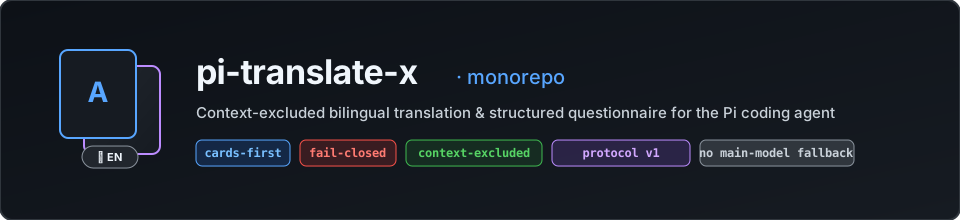




A modular monorepo providing context-excluded bilingual translation and structured questionnaires for the Pi coding agent.
Installation & Setup
Install published extensions directly into Pi:
# Core translator extension (published v0.1.3)
pi install npm:pi-translate-x

# Companion structured questionnaire extension (published v0.1.0)
pi install npm:pi-ask-user-x
Run the interactive setup wizard in the Pi TUI to select your human language and authenticated translation model (requires pi-translate-x >= 0.1.3):
/translate-x setupTool Name Migration & Checkout Trial
- Published
pi-ask-user-x@0.1.0: Exposes the tool under the historical namebilingual_questionnaire. - Workspace Checkout
0.1.1(Prepared): Renames the model tool toask_userwith a neutral description (structured questions / choices / freeform) and neutral UI defaults. - To run a safe local trial directly from this repository checkout (with
ask_userand root0.1.3):
pi --no-extensions --extension ./src/index.ts --extension ./packages/ask-user/src/index.tsCore Flow: Canonical English Architecture

Canonical English → Translated Display → English Answers
- Input Interception: Human input prose is intercepted and translated into prepared canonical English before it reaches the main model.
- Prepared Human Prose Boundary: User-submitted prose is translated to canonical English and confirmed questionnaire answers resolve to canonical IDs/English prose. Translations and UI cards are excluded from model context. Note: Tool execution output, files, diffs, and system context are not translated wholesale.
- Cards-First Display: Assistant responses stay in canonical English, while translated prose is rendered as separate persisted cards.
- Stable Questionnaire IDs:
ask_useris a separate tool registered bypi-ask-user-xthat does not intercept the separateask_user_questionplugin. Predefined options resolve by immutable string IDs, back-translating only custom notes and freeform prose.
Monorepo Packages & Layout
| Package | Version | Path | Description | Key Tools & Commands |
|---|---|---|---|---|
pi-translate-x |
0.1.3 (verified published) |
. (root) |
Translation core, cards engine, and event-bus service | /translate-x setup, /translate-x status, /translate-x retry |
pi-ask-user-x |
0.1.0 (published) / 0.1.1 (prepared) |
packages/ask-user |
Companion structured questionnaire extension | Tool: ask_user (0.1.1 prepared; bilingual_questionnaire in published 0.1.0) |
pi-translate-x/
├── package.json                   # Root translator manifest (pi-translate-x@0.1.3)
├── src/                           # Input/output translation pipeline & pi.events service
├── packages/
│   └── ask-user/                  # Workspace package (pi-ask-user-x@0.1.1 prepared)
│       └── src/                   # ask_user tool & responsive TUI
├── docs/                          # Developer & architecture documentation
│   ├── index.md                   # Documentation index
│   ├── translation.md             # In-depth translation pipeline guide
│   ├── questionnaire.md           # Questionnaire tool guide & runnable schema
│   ├── releases.md                # Release verification & workflow guide
│   └── assets/                    # Standalone SVG banner & architecture diagrams
├── scripts/                       # Manifest allowlist & tarball closure validators
├── CONTRIBUTING.md                # Contribution boundaries & guidelines
└── ROADMAP.md                     # Integration roadmap & host rendering status
Essential Constraints & Cards
- Fail-Closed Behavior: Applies only when input translation is configured and enabled. If an active translation fails, submission halts and the TUI prepends original human text to the current draft. Disabled, unconfigured, or malformed configurations bypass translation and pass raw input directly to Pi.
- Paid Translation: Translation is an independent model call consuming tokens. There are no claims of cost reduction or token savings.
- No Main-Model Fallback: Translations use only the configured provider/model. No fallback to the main agent model or unauthenticated providers. Malformed config disables translation and bypasses input.
- Provider Extensions & Load Order: The translation model is resolved lazily on each request from Pi's live model registry, never at load time, so provider extensions can load before or after pi-translate-x and can re-register their catalogs at any time. On a miss, pi-translate-x asks Pi to refresh the relevant provider once (bounded to 15 s, then a 30 s cooldown) before reporting
Translation model … not found. - CLIProxyAPI Compatibility: Works with a
models.jsonCLIProxyAPI provider and with the router-for-me (cliproxyapi), xiangsam and 0xRichardH (cpa) provider packages. When the configured provider is a CLIProxyAPI one (cliproxyapi,cpa,CLIPROXYAPI_PROVIDER_ID/CLIPROXYAPI_PROVIDER_NAME, or a provider whose id or display name contains "CLIProxy"), the same model id is also looked up under the other registered CLIProxyAPI providers. Socliproxyapi/claude-haiku-5-5keeps working after you switch to a package that registerscpa. Non-CLIProxyAPI providers are never rerouted./translate-x statusshows the model that was actually resolved. Research and design notes are in docs/cliproxyapi-compatibility.md. - Sensitive Persisted Records: Custom cards (
pi-translate-x:input,pi-translate-x:output) and submitted questionnaires are saved to session history (context-excluded). - In-Memory Drafts: In-progress questionnaire selections and cancelled flows stay in memory and are discarded; only submitted answers are persisted.
- Literal Protection: Code blocks, inline backticks, URLs, file paths, and internal placeholders receive best-effort lexical masking in
src/core/protection.ts; arbitrary$shellsyntax is not masked. Inputs beginning with/or!bypass the input translation hook entirely. - Partial Context Scope: Tool calls, file buffers, and execution output are not translated wholesale into English; only human-facing prose.
Execution Modes & Verified Limits
| Mode | Translation (pi-translate-x) |
Questionnaire (pi-ask-user-x) |
|---|---|---|
TUI (ctx.mode === "tui") |
Interactive setup, status, retry, and bilingual cards. User TUI acceptance testing has verified interactive behavior. | Full responsive layout reflows (side-by-side, stacked, compact down to height 1 row). |
Native RPC (ctx.mode === "rpc") |
Configured input translates safely; output stays canonical English; setup notifies and exits. | Degrades gracefully to native Pi RPC dialogs (ui.select, ui.input, ui.confirm). |
Headless (json/print) |
Configured input translates safely; output stays canonical English. | Explicitly unsupported; returns "Headless execution is not supported". |
Verification note: Automated tests use deterministic mocks. While layout tests verify responsive dimensions down to 1 row, no claims are made regarding full provider matrices, hardware terminal cursors, or assistive technologies.
Releases & Developer Documentation
- Documentation Index
- Translation Pipeline Guide
- Questionnaire Tool Guide & Schema
- Release Operations & Verification
- Contributing Guidelines
- Project Roadmap
pi-translate-x@0.1.3 is verified published on npm via GitHub Actions OIDC trusted publishing (workflow run 40629946624). pi-ask-user-x@0.1.0 is published on npm via manual bootstrap (future automated releases prepared; npm owner trust pending).
Repository: dogalyir/pi-translate-x. MIT License.